
What Happened to the Harley-Davidson V-Rod?
For more than 120 years now, Harley-Davidson has been a major player in the worldwide motorcycle market. Its 1915 11F is largely considered its first truly successful model with record-breaking sales of 9,855 units. That was phenomenal for its time. By 1920, the company was the world’s largest motorcycle manufacturer and had developed a massive global following.
Over time, Harley produced a long list of additional bestsellers. Those include the Knucklehead from 1936 to 1947, the Hydra-Glide that was produced from 1949 through 1957, and the Sportster that came into play in 1957 and was a member of the company’s lineup until 2022. There were also the Electra Glide that got its start in 1957 and the Super Glide that was made from 1971 through 1984.
Those models barely scratch the surface. Over time, Harley-Davidson has brought a range of fabulously popular models to the market from the Fat Boy and Heritage Classic to the Road King and Ultra Limited. There’s no denying that HD has made a name for itself in the touring, cruiser, and adventure motorcycle categories as well as the trike sector.
Enter the V-Rod
Of course, Harley hasn’t always stayed strictly within those basic categories. It has also ventured into the realm of high-performance bikes, and one of the most famous results of those efforts was the V-Rod. It went into production in 2001, and it was a significant departure from HD’s conventional selection.
At the time, the company was facing serious competition from certain foreign manufacturers. Yamaha started edging into the American market with its V-Star line in the late 1990s. Honda had been a thorn in Harley-Davidson’s side for several decades at that point, but during the 1990s and 2000s, its Gold Wing and Shadow lineups truly took off. Suzuki, Kawasaki, BMW, and Ducati were also rising to fame.
Those manufacturers took much of their inspiration from Harley-Davidson, and they definitely coveted the company’s popularity. They set out on a mission to not only offer American bikers the same features they loved about Harleys but also give them more speed and modern amenities in a less expensive package. Though they didn’t really sway the older, more dedicated HD fans, they did draw the attention of the younger generation.
In response, Harley built the V-Rod. They began planning for it in the 1990s and finally released it for the 2002 production year. It was designed to appeal to younger riders as well as those who were looking for more speed and agility. It bridged the gap between the company’s long-running legacy and the growing high-performance market, and it proved that Harley-Davidson could hold its own against its competitors. Even today, it’s a highly sought-after model among riders who want to buy a motorcycle.
What Made the V-Rod Stand Out?
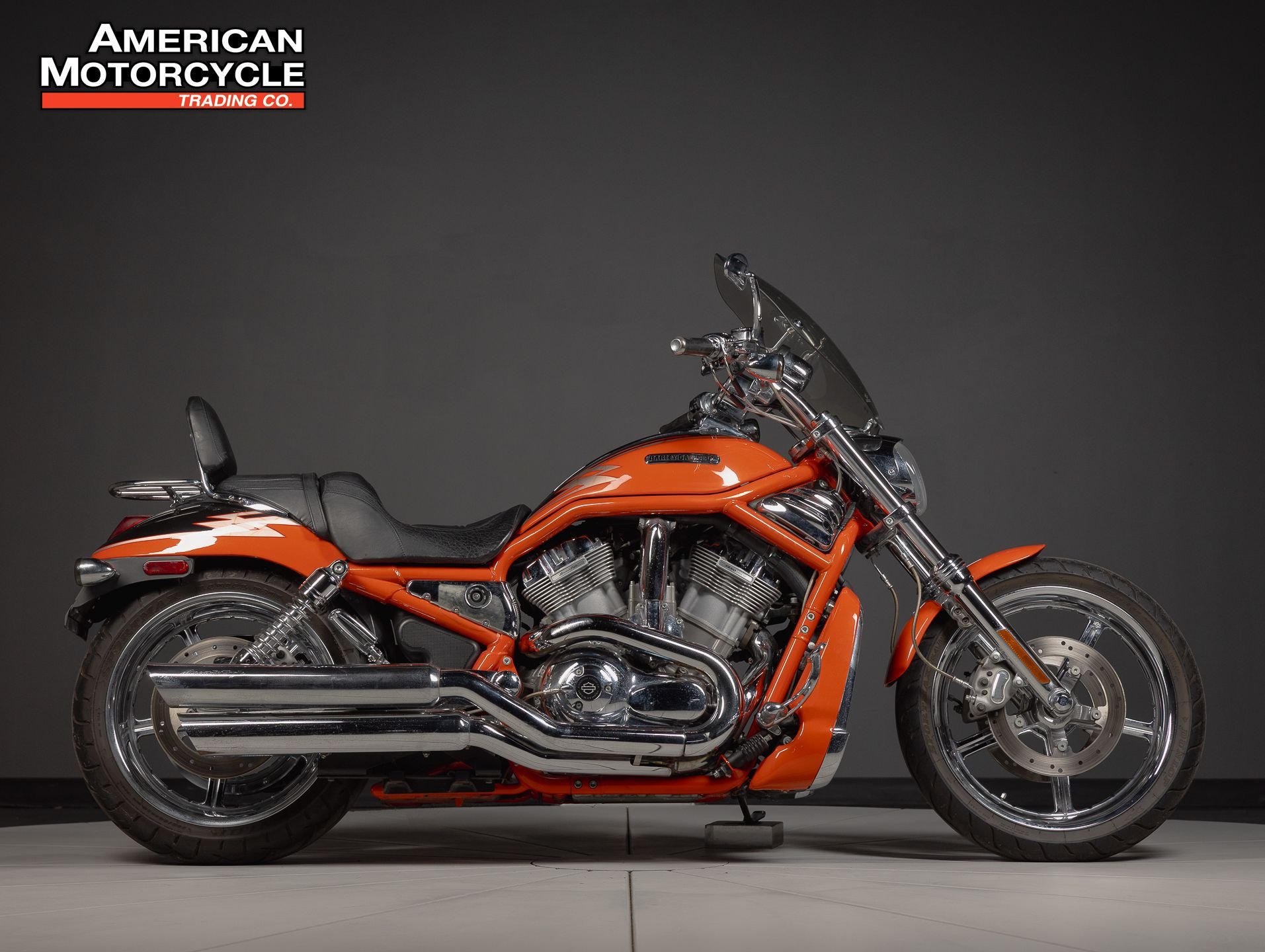
Several features made the V-Rod stand out in the world of motorcycles and from Harley’s conventional lineup. Its revolutionary engine was one of them. In fact, it was called the Revolution engine, and with good reason. Born of a joint effort between Harley and Porsche, it was liquid cooled as opposed to HD’s traditional air-cooled design. In contrast to the company’s typical pushrod V-twins, it had dual overhead cams.
It also had four valves per cylinder instead of the standard two. That gave it better airflow and internal combustion, which equated to more horsepower and improved efficiency. It was Harley’s most powerful production engine at that time, producing up to 115 horsepower compared to the usual 60 to 80 of its other engines. The V-Rod’s Revolution engine left behind the carburetor in favor of fuel injectors too.
That being said, a more advanced and powerful engine wasn’t the only new feature the V-Rod had to offer. It got a complete makeover as well. Though the company held onto its classic cruiser style to an extent, it also revamped its overall design with this new bike. Since it was liquid cooled, it needed a radiator, which previous Harleys didn’t have. They made that radiator a focal point of the V-Rod’s style.
It had a more angular fuel tank that didn’t look much like the usual smooth, teardrop-shaped versions. Its beefier frame gave it a more aggressive look than its predecessors, and its seat and handlebars placed the rider in a more forward-leaning position. After all, the V-Rod was destined to have a sportier look and feel than your typical cruiser.
Harley-Davidson also updated the V-Rod’s exhaust to give it a more modern appearance. Even its redesigned engine made it look different than the norm. On top of all that, the V-Rod came with a selection of more contemporary paint jobs. The Night Rod Special took all those features even further with its blacked-out color scheme, minimalistic body work, and more pronounced angles.
How Popular Was the V-Rod?
In many ways, Harley-Davidson achieved its goals with the V-Rod. It definitely caught the eye of the younger crowd as well as dedicated Harley fans who were looking for a sportier alternative to the company’s conventional bikes. It won over many riders who had previously been committed to HD’s foreign competitors. It even outshone those manufacturers in some countries.
There’s no denying that the V-Rod developed a cult following all its own. Based on some reports, an estimated 60,000 were sold within its first four years in production. Around 150,000 were sold throughout its production run. It’s still in high demand today.
Still, those sales figures are low compared to other models. To put matters into perspective, more than a million Sportsters have been sold over the years, and Fat Boy sales have likely
reached hundreds of thousands. Although the V-Rod was never one of Harley’s bestsellers, it’s considered a classic and a collectors item.
So, What Happened to the V-Rod?
After 15 years in production, the last V-Rods rolled off of the assembly line in 2017. Why did Harley-Davidson discontinue it? With it being a success both in America and abroad, why didn’t they keep making it and creating new iterations along the way? Well, several factors come into play here.
High Production Costs
For one, the V-Rod was more expensive to manufacture than other models. Its Porsche-designed engine alone caused complications in this arena. It required an entirely different range of manufacturing equipment than Harley’s other models. It was a more complex engine as well, which meant that it had more components and required more precision in manufacturing.
Because of all that, production costs were higher for the V-Rod, and those costs were ultimately passed along to consumers. Many riders weren’t willing to pay more for it, though, especially when they could get similar performance from less expensive brands. Factoring in the V-Rod’s higher maintenance costs only made matters worse. While Harley could easily compete with those brands where quality and performance were concerned, they couldn’t compete with their prices.
Fewer Customization Options
Additionally, the V-Rod had far fewer opportunities for customization than many of Harley’s other models. One of the reasons why so many people love HD motorcycles is the ability to modify them and make them their own. At that point, all the conventional customizations revolved around traditional Harleys. Since the V-Rod was so radically different, conventional modifications just didn’t work.
Beyond that, the few custom parts that eventually became available for the V-Rod cost more. Having them installed did too. Given that the motorcycle itself already came with a higher price tag than Harley fans were accustomed to, many riders didn’t have the budget or the inclination to modify it.
Straying Too Far From the Norm
Most Harley fans have a set-in-stone picture in mind of what a Harley motorcycle should be, and the V-Rod just doesn’t fit that mold. It’s not just about the bike’s appearance, either. An entire community and culture have evolved around the HD brand and image. They love its classic style, the feel of the bikes, and the rumble of their exhaust. They’re committed to its craftsmanship and American-made authenticity.
As far as many long-time HD fans were concerned, the V-Rod broke all of those rules. Though it still bore the Harley-Davidson name, it wasn’t the same. It didn’t look, sound, or feel like a Harley. They felt that the V-Rod lacked the heart and soul they’d come to expect from HD. That didn’t turn them against the brand in general, but it definitely caused them to turn their backs on that specific model
Declining Sales
Finally, there was the problem of declining sales to contend with. Though demand for the V-Rod was initially fairly strong, that didn’t last long. Between resistance from traditionalists and the high cost of the V-Rod, sales continually declined over the years it was in production. In the end, its profits didn’t justify its costs of production. Harley-Davidson ultimately decided to discontinue it and transition back to its heritage.
Going Back to Harley-Davidson’s Roots
The V-Rod wasn’t a failure by any means. Harley-Davidson built it to prove that they could bring the same levels of speed and performance to the market as their strongest foreign competitors. They accomplished their goal.
Quite a few people might argue that they didn’t really have anything to prove, though. When the V-Rod went into production, they’d already built a solid reputation for endurance, reliability, speed, and performance. In less than two decades, they went from working out of a tiny backyard shed to being the biggest motorcycle manufacturer in the world.
They were coming out on top in Federation of American Motorcyclists events in the early 1900s before they really even got off the ground. Their bikes have forged through combat and helped keep law enforcement officials on the road. They established a name for themselves in the world of racing as well, even winning the Springfield National Mile and the Colonial Downs the year the V-Rod went into production. They had more than proven themselves at that point.
While the V-Rod had its own level of success, it didn’t mesh with the Harley-Davidson tradition, and many fans weren’t impressed by it. That brought the company to the realization that their strength lies in their heritage and authenticity. They have numerous attributes that other brands can’t compete with, and those are what truly make HD bikes special. As such, they decided to shift back to their heritage and focus on their core models. Though they’re still introducing innovations, they’re working hard to make sure those don’t take their bikes away from their roots.
ABOUT THE AUTHOR

Jake Robison

Jake Robison has operated powersports dealerships since 2003. With an extensive background in the motorcycle industry including sales, service, parts, finance, management and powersports training, he covers all things motorcycles and enjoys sharing valuable information to newcomers on two-wheels